
Free earthworks ITP and lot register templates
A practical inspection and test plan template and lot register template for Australian civil earthworks, in CSV and printable PDF. Free download, no signup, no email required.
Take the files, no strings
Each file is a general-purpose starting point built around the way earthworks lots are actually opened, tested and closed out.
Earthworks ITP template
CSV, 3 KB
Fifteen example rows covering pre-start, topsoil strip, subgrade, fill placement, pavement layers and lot close-out, with columns for spec clause, inspection or test, frequency, acceptance criteria, hold or witness point, responsibility, record and sign-off.
DownloadLot register template
CSV, 1 KB
Lot number, date opened, chainage from and to, offsets left and right, construction layer, area or volume, ITP reference, test report numbers, status, conformance date and comments, with example rows you replace.
DownloadBoth templates, printable
PDF, 3 pages
A one-page how-to-use guide, the full ITP table and a blank lot register laid out for A4 landscape printing, ready for a site folder or a toolbox handout.
DownloadThese templates are a general starting point. They are not a substitute for your contract specification or approved project quality plan, and every clause reference, frequency and acceptance criterion must be replaced with your project's own requirements before use.
What each ITP column is for
An ITP fails on site when a column is left vague. Here is what belongs in each one.
Stage and activity
The work element being verified, in construction sequence. Keep one ITP per activity rather than one giant plan for the whole job.
Spec clause reference
The clause the check verifies. Without it nobody can tell whether a test is contractual or habit.
Inspection or test
What is actually done: visual inspection, field density test, proof roll, conformance survey, laboratory grading.
Frequency
How often, expressed the way the specification does: per lot, per lift, per tonnage, per source change.
Acceptance criteria
The pass condition, in measurable terms. "Meets specified density ratio" is only useful if the clause reference is filled in beside it.
Hold, witness or surveillance
H stops work until the nominated party releases it. W invites attendance after notice. S is monitoring only.
Responsibility
Who performs the check: site engineer, surveyor, testing authority, superintendent.
Record and sign-off
The evidence produced and the space for the name and date that closes the item out.
What each lot register column is for
The register is the index the superintendent audits at handover, so every row should stand on its own.
Lot number
Prefix by layer so the number itself tells you what it is, for example SG-001 for subgrade or CAP-004 for capping.
Chainage from and to, offsets
The parcel's location along the alignment. This is what makes a lot auditable years later.
Construction layer
Topsoil strip, subgrade, capping, subbase, base course. One lot per layer, even over the same ground.
Area or volume
Drives the testing frequency and feeds progress claims. Calculate it once and keep it with the lot.
ITP reference and tests
Which plan the lot was built under and the report numbers holding the raw results.
Status and conformance date
Awaiting inspection, awaiting testing, passed or rework required, then the date the lot was released.
One subgrade lot, start to finish
How a single lot moves through the ITP and lands in the register.
Open the lot
Subgrade from chainage 1,200 to 1,400, 0 to 8 m left, 1,600 m². Lot SG-001, built under ITP-EW-02. Status: awaiting inspection.
Condition and compact
Moisture conditioning is monitored under surveillance; field density testing is called at the specified frequency. Status moves to awaiting testing.
Release the hold points
Density results pass, the proof roll is witnessed by the superintendent with no deflection, and the conformance survey confirms level and shape.
Close it out
Test report DEN-1042 is recorded against the lot, status becomes passed, and the conformance date is entered. Only now can capping lot CAP-001 be placed over the same footprint.
If it fails
The lot is marked rework required, is not covered, and is either reworked and retested or reduced in extent so the failing portion is isolated. The register keeps the original result, the disposition and the retest.
Where a spreadsheet register runs out
The templates work. They stop working at scale, and it is always for the same three reasons.
It has no location
A chainage range in a cell tells you nothing about what is actually built where. Nobody can look at the sheet and see which stretch of corridor is still open.
It cannot check itself
Gaps between lots and overlapping chainage ranges are invisible in a spreadsheet until the superintendent finds them in the handover pack.
It multiplies
One register becomes the site copy, the office copy and the version in someone's email, and the conformance dates stop agreeing.
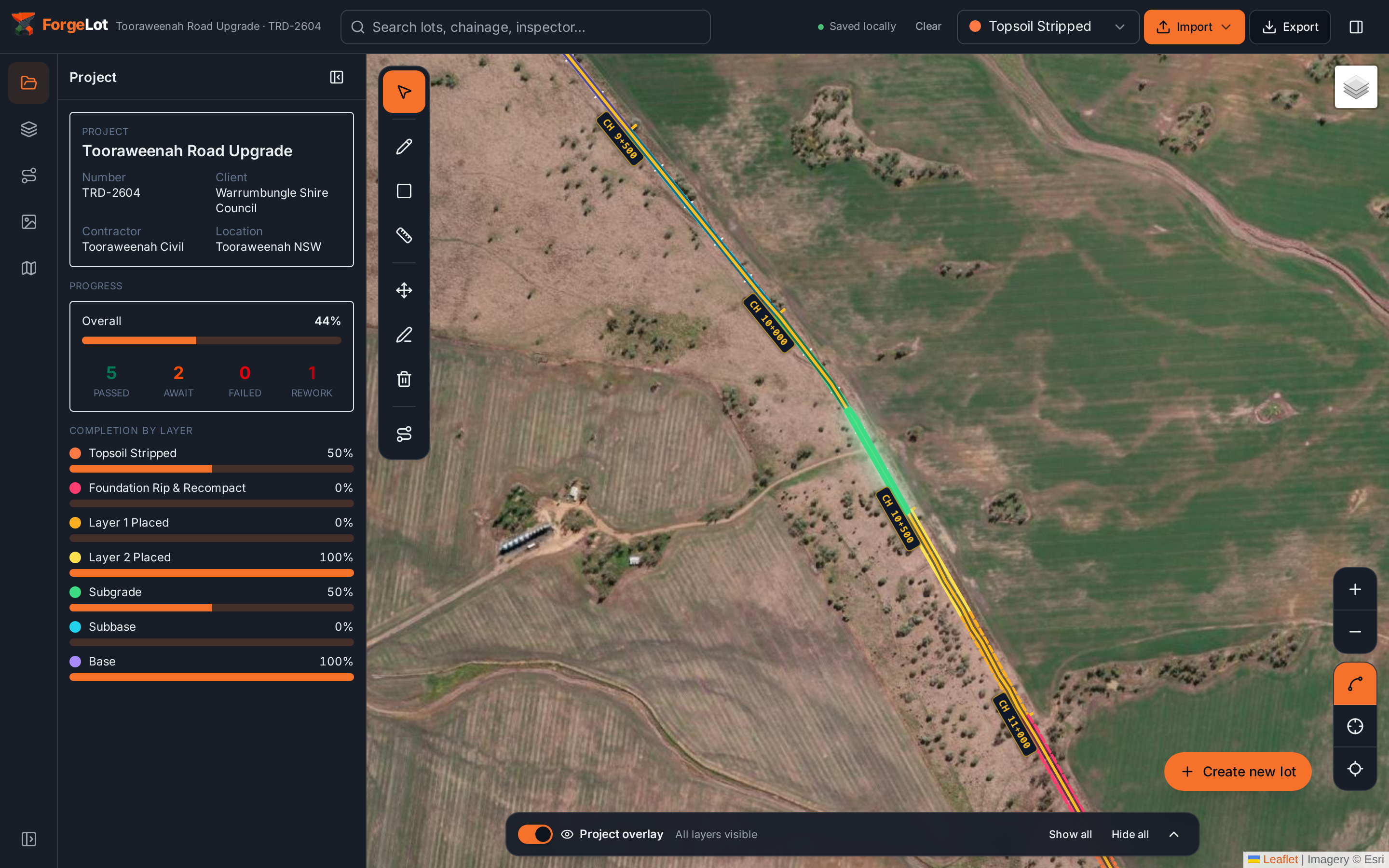
ForgeLot builds the same register from your DXF alignment. Lots are created by chainage and offset, the area is calculated for you, ITP status sits on the geometry, and the register still exports to CSV and PDF for the superintendent.
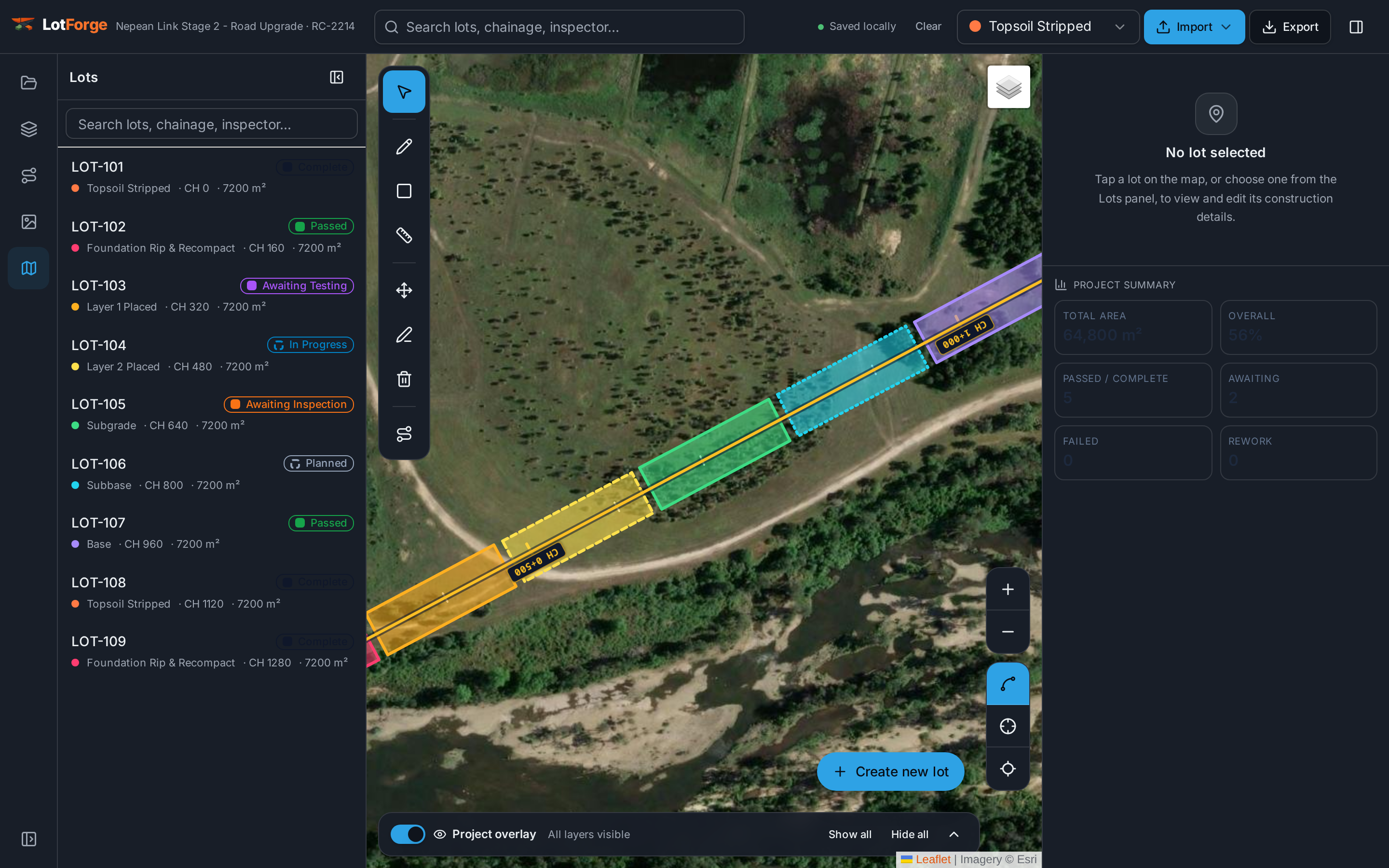
The register, on the corridor
Because status lives on the lot geometry, completion by layer and the conformance summary come from the same records the crew updates on site.
Template FAQs
New to lot-based quality records? Start with inspection and test plans and lot registers explained, or grab the free civil site diary template.
Stop guessing what's been built.
Import your alignment, forge your lots and share a live picture of progress with the whole team.
14-day free trial · Cancel anytime · Your data stays yours