
Free civil site diary template
A daily site diary and earthworks record built for Australian civil projects, in CSV and printable PDF, with a companion plant and labour sheet. Free download, no signup, no email required.
Take the files, no strings
Built around the way an earthworks day actually runs: weather, crews, plant hours, chainages, lots, tests, delays and instructions.
Daily site diary template
CSV, 31 columns
One row per day covering weather and rainfall, shift times, personnel and subcontractors, plant hours, work areas by chainage and offset, lots opened and conformed, tests, hold points, delays, instructions, safety and environmental notes. Two worked example days are included for you to overwrite.
DownloadPlant and labour daily record
CSV, 14 columns
A companion sheet for machine-by-machine hours: fleet ID, owner or hire company, operator, start and finish hours, working, idle and breakdown time, work area, task and docket reference so hired-plant claims reconcile with the diary.
DownloadPrintable diary sheet
PDF, 3 pages
A how-to-use page, a full-page A4 landscape daily diary form ready to print for the site folder, and a blank plant and labour record for the same date.
DownloadThese templates are a general starting point. They are not a substitute for your contract requirements, approved project quality plan or your organisation's record-keeping obligations, so check the fields against your contract before you roll them out.
What belongs in each field
A diary is only worth what it records. These are the entries that get read again months later, usually by someone assessing a claim.
Date, shift times and weather
Record weather morning and afternoon, rainfall in millimetres and the state of the ground. Weather is the single most disputed field in any extension-of-time claim, and it costs ten seconds a day to get right.
Personnel and subcontractors
Names, roles and hours for your own crew, plus which subcontractors were on site and with how many people. Numbers alone are useless when you later need to prove who was standing.
Plant and equipment
Type, fleet or hire ID and hours for each machine. Separate working hours from idle and breakdown time; that split is what turns a diary into a standby claim.
Work areas and work performed
Chainage from and to plus offsets, then a plain description of what was done. Locations, not just activities, so the diary can be matched back to lots and surveys.
Lots opened and conformed
Which lots were opened, which were closed out and which tests were called. Keeping this in the diary means your daily record and your lot register never drift apart.
Hold and witness points
Who was notified, when they attended and whether the point was released. Note the time; a missed witness point is normally about notice, not about the work.
Delays and lost time
Cause, start and finish time, resources standing and the party responsible. Vague entries like "rain, lost time" are worth close to nothing months later.
Instructions, variations and directions
Every verbal or written instruction, who gave it and the reference number. If it was verbal, say so and note that you confirmed it in writing.
Safety and environmental
Toolbox topics, inductions, incidents and near misses, plus sediment control checks, dust, noise and any discharge. Regulators ask for contemporaneous records, not reconstructions.
Deliveries, visitors and sign-off
Materials received with source and quantity, who visited site, then the name, position and date of the person who wrote the entry. An unsigned diary is a weak record.
Three rules that keep a diary useful
Most diaries fail for the same three reasons, and none of them are about the template.
Write it before you leave site
A diary written the next morning loses times, names and the exact wording of an instruction. Fifteen minutes at the end of shift is the whole discipline.
Facts, quantities and references
Times, chainages, tonnages, test numbers, instruction references. Opinions about who was at fault do not help you and can hurt you.
Never backdate or overwrite
If something was missed, add it as a later dated entry that says when it was recorded. A diary that has clearly been edited stops being evidence.
One day, written properly
The same shift, recorded the way the template intends.
Conditions
Monday 2 March. Fine 14C in the morning, fine 24C in the afternoon, no rainfall, surface dry and trafficable. Shift 06:30 to 16:30.
Resources
Site engineer and foreman for 10 hours each, six operators from the earthworks subcontractor, D6 dozer DZ-02 for 8.5 working hours and 0.5 idle, 30 t excavator EX-11 hired under HIRE-8871 for 9 hours.
Work and lots
Subgrade trim and compaction CH 1,200 to 1,400, 0 to 8 m LHS. Lot SG-001 opened over 1,600 m². Topsoil lot TS-004 conformed. 420 t of select fill imported from Northern Quarry.
Tests and hold points
Three field density tests called, report DEN-1042, all pass. Proof roll witnessed by the superintendent's representative at 14:10 and released. Conformance survey issued for the same extent.
Everything else
Instruction SI-018 received clarifying trim tolerance. Toolbox on exclusion zones, one visitor inducted. Sediment fence inspected, no discharge. Nil delays. Signed by J. Smith, site engineer, same day.
Where the diary and the quality records stop agreeing
The diary says a lot was opened at chainage 1,200. Nothing in the spreadsheet proves it, or shows you what is still open along the corridor.
Two records, one truth
The diary and the lot register are maintained by different people at different times, so lot numbers, dates and extents drift apart until someone reconciles them at handover.
No picture of the corridor
A chainage typed into a cell cannot tell you which stretch is trimmed, which is tested and which is still open. That only becomes visible on the alignment.
Evidence assembled late
Pulling a claim or handover pack together from months of separate sheets is where days disappear, and where gaps in the record are discovered far too late.
Keep the diary as your daily narrative, and let ForgeLot hold the lot side of the record on your DXF alignment: lots created by chainage and offset, areas calculated for you, ITP status on the geometry, and CSV or PDF exports for the superintendent.
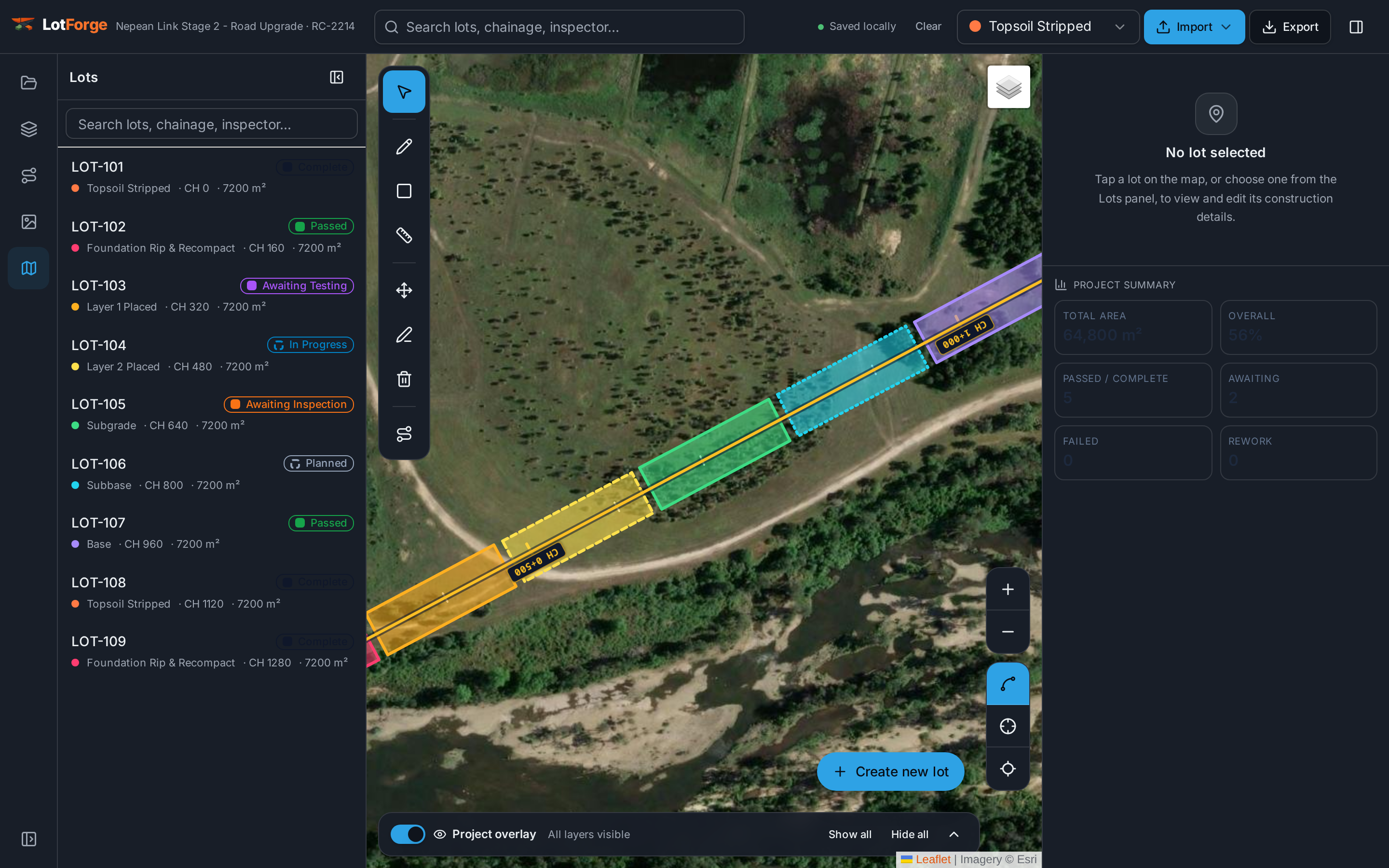
From daily records to project position
When lots carry their own status, completion by layer and the conformance summary come out of the same records the crew updates on site.
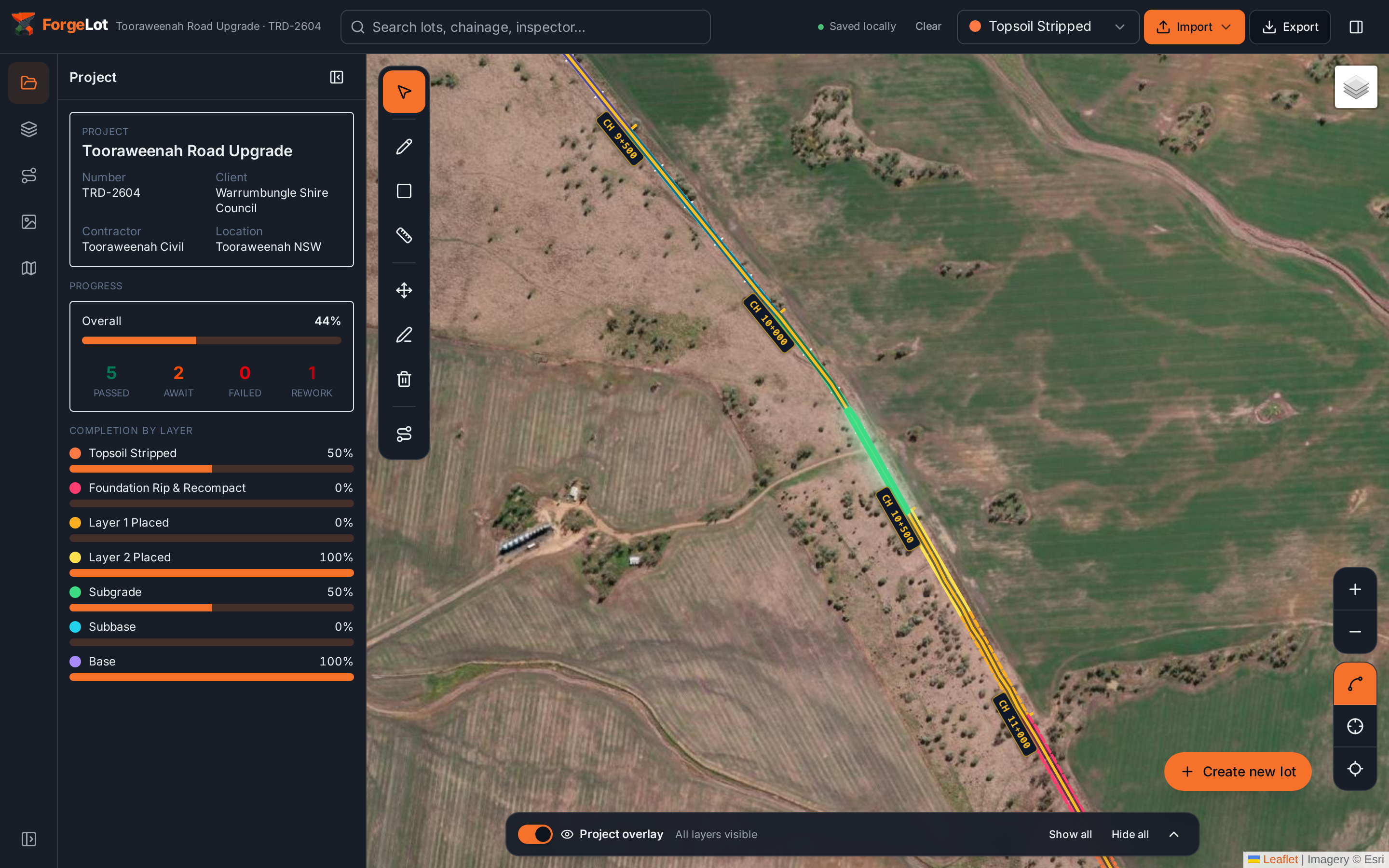
Site diary FAQs
Need the quality side too? Download the free ITP and lot register templates or read the MRTS04 earthworks lot guide.
Stop guessing what's been built.
Import your alignment, forge your lots and share a live picture of progress with the whole team.
14-day free trial · Cancel anytime · Your data stays yours